
A few years ago, I put together my first workout split: a basic, Push-Pull-Legs routine with one rest day per week. Simple, yet effective. It was something that I could cater towards my fitness ‘wants and needs’ as well as provide a structure that many of the other programs scattered throughout the internet did not have. Fast forward to today, and that same split works just as effectively as it did when I first stepped into the gym.
Rising to prominence in the 80s to 90s era of bodybuilding, the Push-Pull-Legs split was a popular program that many famous bodybuilders from Lee Labrada to Lee Haney utilized in their early training years. But what exactly does the Push-Pull-Legs split entail? What makes it different from other routines?
Push Day, as indicated by its name, revolves around push-based exercises such as bench press and overhead press that involve movement away from the body. Primarily, these exercises focus on the chest, shoulders, and triceps. Pull Day consists of pull-based exercises such as pull-ups and barbell rows that emphasize movements of pulling weight towards your body. These exercises focus mainly on the back and biceps. Lastly, Leg Day rounds out the split, working out the body’s biggest (and arguably most important!) muscle group. From squats to calf raises, it’s essential to put together a leg day repertoire that hits all of the components of our lower body: quadriceps, glutes, hamstrings, and calves. However, the beauty behind the split is that one can easily rearrange, add, or remove exercises while maintaining a solid workout routing.
What you see below is the exact routine I used when I first started lifting, a program that I still find myself running to this day (barring a few minor adjustments I’ll incorporate every now and then).
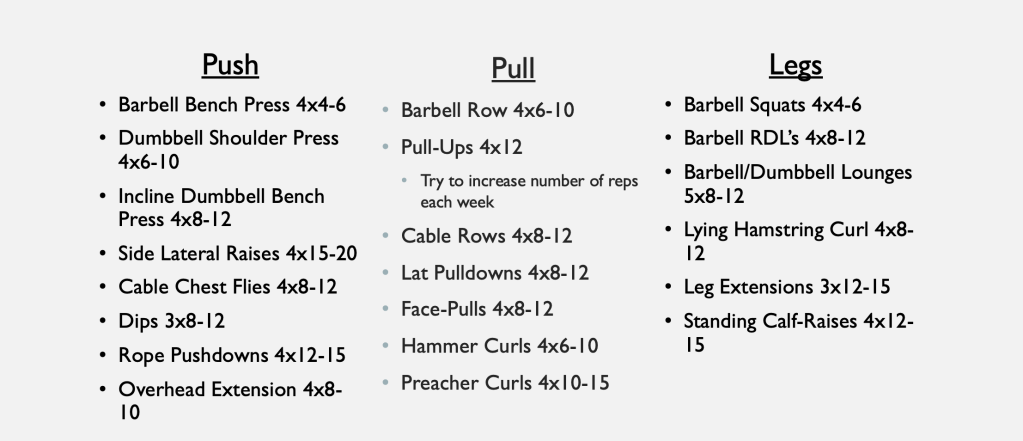
A typical week of PPL looked like Push, Pull, Legs, Push, Pull, Legs, Rest… (PPLPPLR) or Push, Pull, Legs, Rest, Push, Pull, Legs, Rest… (PPLRPPLR) depending on what my body felt like at the time.
Now, why the Push-Pull-Legs Workout split when there are so many other workouts out there?
Great question! I’ve asked myself that a few times and have even tried other workout routines every now and then, but I always find myself gravitating back to a basic PPL split for a few reasons that I’ve outlined below
1. Less is often more ✅
Something that I’ve learned over the last few years is doing too many exercises for one body part will actually have the opposite effect that I may think, resulting in overuse and overtraining that’s detrimental towards hypertrophy. With PPL, however, you’ll never run this risk. Each of the three days were are built so that there’s major overlap between muscle groups that you don’t have to incorporate so many exercises into the day! For example, bench press will work out your mid-chest and triceps, while the dumbell press will hit both the front and side delts as well as the triceps. Thus, if wanted, one can easily remove an exercise or two and still have an effective workout.
2. The ‘2x per week’ rule ‼️
There’s a gold standard for the frequency in which we should be workout each body part, and that’s twice per week. By performing PPL in the standard way each week, each individual upper and lower muscle group will be worked out effectively at the proper rate to allow for muscle symmetry and a balanced workout every day.
3. Accounting for periodization 🚨
In order to maximize muscle growth and reduce muscle adaptation, periodization is a crucial aspect of building a workout. By periodization, we mean mixing up exercises after an extended period of time in order to prevent our muscles from adapting and getting used to those specific exercises. Luckily, PPL allows for easy substitution of exercises when necessary. For example, after a month or two of performing shoulder press with dumbells, one can switch to a barbell overhead press, or instead of starting a pull day with barbell rows, start with weighted pull-ups. The split allows for us to ‘shock the muscle’ and restructure our workouts in order to maximize performance.
4. Catering to every level 🏋️
Whether it’s your first day in the gym or about step on stage, PPL can be performed by anyone at any level and will prove to be effective. It’s by far the most popular workout split in the bodybuilding community, especially for those who are new to working out.

So, is the Push-Pull-Legs split the most effective workout? I would argue that for those new to the gym looking to build muscle, then yes, PPL is the way to go! It’s the simplest yet most effective routine to build muscle. However, for those who are serious about competing and a bit more advanced, a more specific routine that’s catered towards strengths and weakness is probably better.
Most importantly, though, is to find a workout routine that best fits your goals. After all, any form of fitness is fitness, nonetheless. If cutting weight is your main focus, a routine that places more emphasis on cardio and conditioning training is probably better, or if you want to try a more body-weight-oriented regimen, then calisthenics is your best option. To each their own!
 Matthew Raroque